
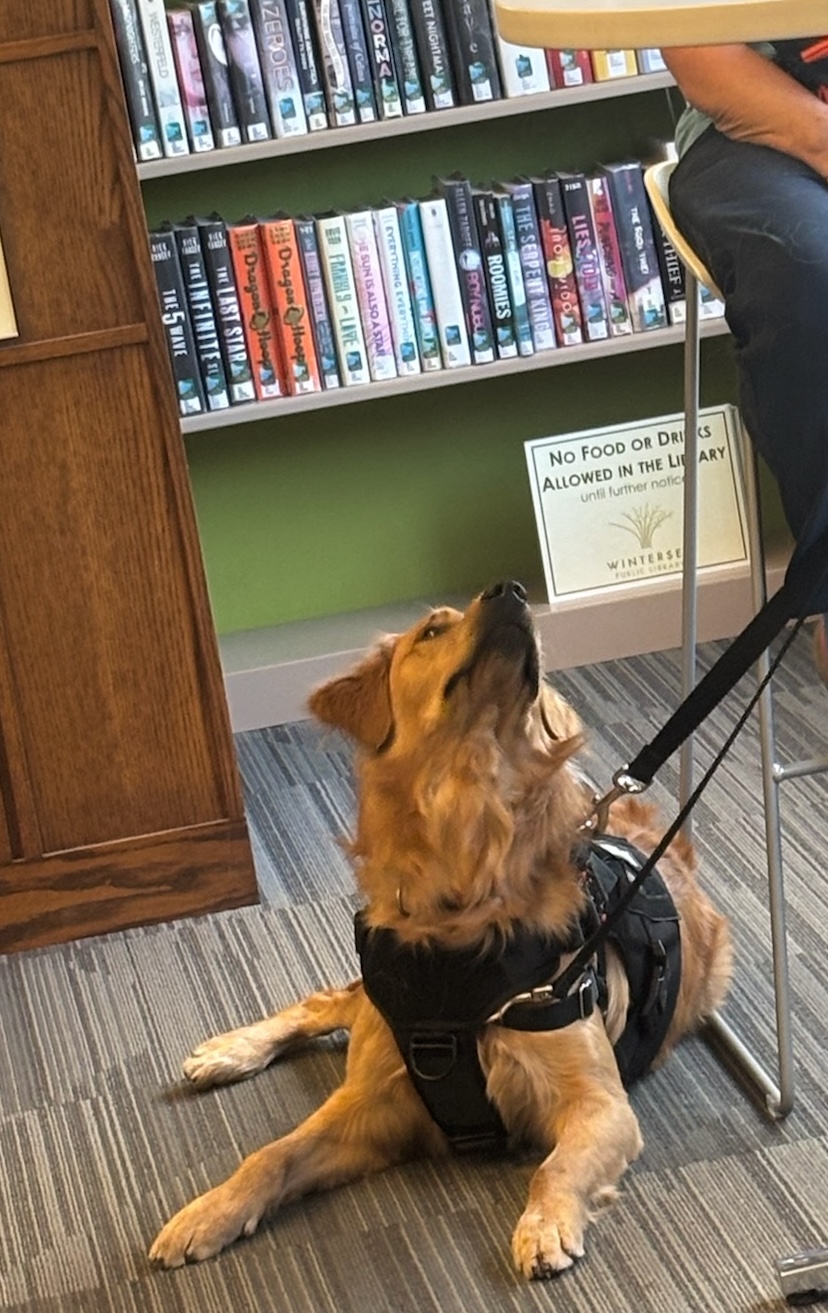
If you're one of my clients working through service dog training with your own dog, you already know the work doesn't stop when a session ends — it's a daily relationship, and how you structure that time matters as much as what you're teaching. A study published this year backs that up with real numbers: researchers tracked 837 assistance-dog sessions across 63 working dogs and 30 professional handlers, scoring how each dog behaved during and after the work. Their conclusion: this kind of work isn't inherently good or bad for a dog. Whether it helps or wears on a dog comes down to how the work is structured — session frequency, who's running it, whether the dog is suited to what's being asked. That holds just as true training at home with me as it does inside a full-scale service dog program.
The clearest finding: it wasn't the length of any single session that predicted a dog losing enthusiasm, it was how many sessions the dog worked in a week. Higher weekly session counts tracked with measurably lower enthusiasm scores — even on days when no individual session ran long. That's exactly why I have clients build in real rest days instead of training every single day. Work every other day where your schedule allows it. If daily practice is what you've got, break it into a few shorter sessions through the day instead of one longer block — you're protecting enthusiasm, not just logging reps. A flattening of drive isn't "she's just tired today" — the data says it's cumulative, and it shows up before a dog starts outright refusing work.
The same study found dogs paired with a handler they didn't know well scored significantly higher on tension. If you're the one doing structured work with your dog, stay the one doing it, at least until the skill is solid; swapping who runs sessions too early adds a real welfare cost, not just a slower-training one. It's the harder version of this same problem that organizations running rotating staff run into — handler continuity isn't a convenience, it's part of the dog's stress load.
The researchers also found a dog's age and experience predicted different things depending on the type of work: older, more experienced dogs settled better into calmer, structured roles but showed more uncertainty in busier, less predictable ones. That maps onto something I already weigh before placing a dog into a role — a dog that's a calm, steady fit for one-on-one mobility support isn't automatically suited to the higher-stimulation demands of public access work with strangers approaching unpredictably. Matching the dog to the real demands of the role, not just handing a trained dog whatever job is needed, is part of protecting that dog's welfare long after training ends.
Sources:
- Haven-Pross et al. (2026). Dogs' Behavioural Responses to Dog-Assisted Interventions: A Field Study. Animals, 16(7):1063. https://doi.org/10.3390/ani16071063