
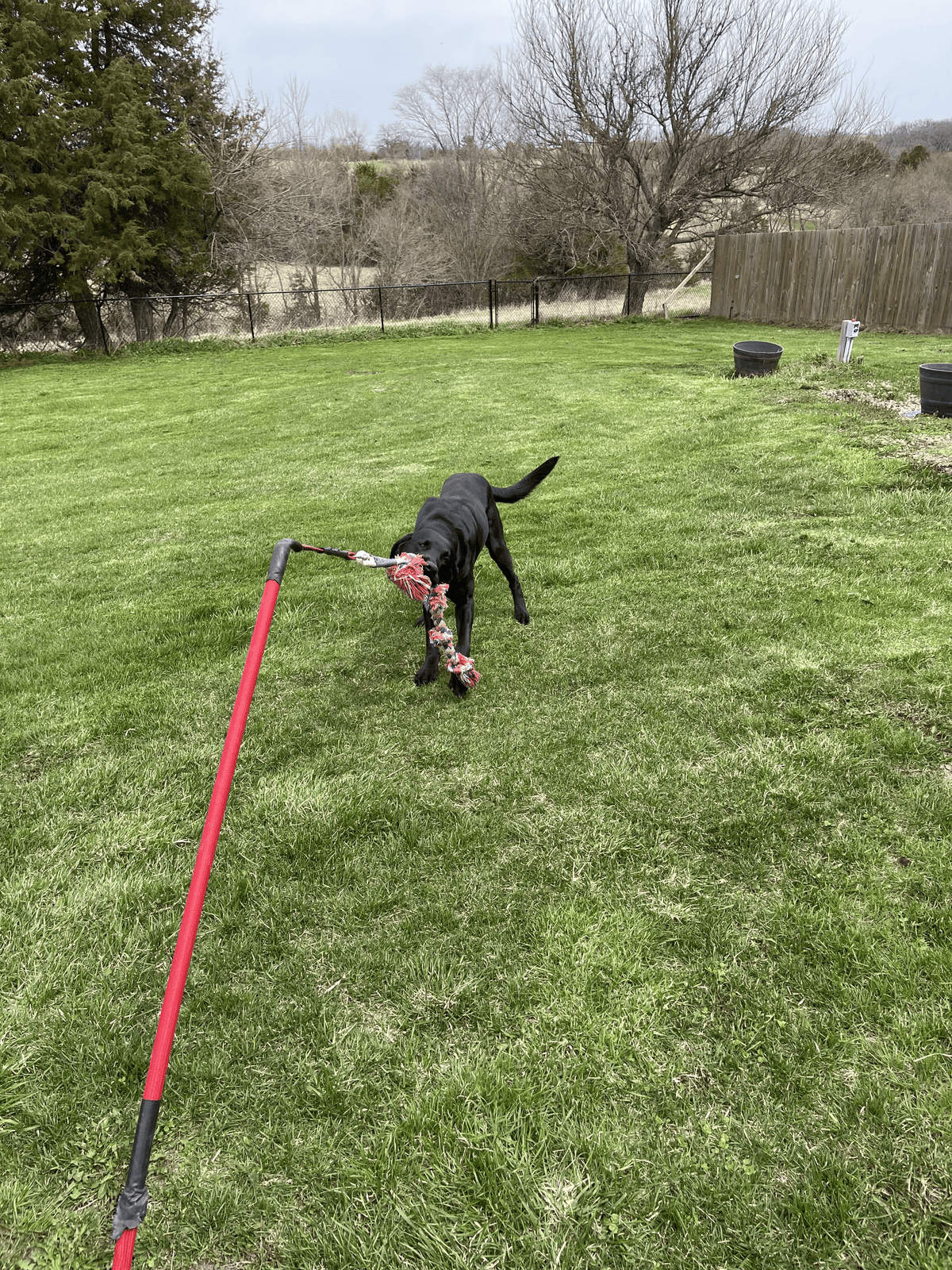
A new study out of Texas Tech looked at 50 shelter dogs who were, in the researchers' words, showing "excessive arousal" — the jumping, panting, vocalizing, can't-settle behavior a lot of you know well. They split the dogs into five groups: minimal walks only, calm enrichment (longer walks plus real interaction), active enrichment (play plus interaction), medication alone, and medication paired with calm enrichment.
The combo group — medication plus calm enrichment — came out on top. But here's the part I want every client to sit with: enrichment alone still beat the minimal-walk baseline. You don't need a prescription to see real change. You need a plan.
That's the piece I see missed constantly. "Enrichment" gets treated like a synonym for "tire him out" — more walking, more fetch, hope it sticks. The study didn't do that. It structured specific interventions, measured specific behaviors (lip licking, panting, jumping, vocalizing), and tracked change over a defined period. That's the same reason I don't hand out a generic enrichment list before I've actually evaluated the dog in front of me.
Why the evaluation comes first
An over-aroused dog and an anxious dog can look identical from the couch — jumping at the door, can't settle, vocalizing. They are not the same dog, and they don't get the same plan. A behavioral evaluation is how I figure out what's actually driving it before I build anything: what's the trigger, what's the threshold, is this arousal or is this fear dressed up as arousal. Skip that step and "more enrichment" is just a guess with extra steps.
Once I know what I'm working with, the plan is criteria-gated, not calendar-gated — we don't move to the next stage because two weeks passed, we move because the dog is consistently meeting the bar we set. Same logic the study used: defined intervention, defined measurement, defined timeline for checking it worked.
Where the vet fits in
The study's best results came from combining enrichment with medication — and that tracks with how I already work. If a dog's arousal or anxiety is significant enough, enrichment and training can do a lot, but they're not a replacement for a veterinary behaviorist when one's warranted. That's not a failure of training — it's the same "combine what works" approach the researchers landed on.
And medication isn't necessarily a life sentence. Board-certified veterinary behaviorists describe it as a bridge, not a permanent fix — it takes the edge off enough that the dog can actually learn the new patterns, and the enrichment and training work builds the skills that hold once it does. Once thresholds shift and the new behavior is solid, some dogs can be tapered down or off entirely, always under the vet's guidance and never abruptly. Not every dog gets there — some need longer-term support — but "started on medication" doesn't mean "on it forever." That's not something this particular study measured — it only ran two weeks — but it's well established in the veterinary behavior literature.
A word on who you hire for this
"Behaviorist" is a specific credential — a licensed veterinarian who's done a residency in behavior and is board-certified through the American College of Veterinary Behaviorists (DACVB). That's who diagnoses and manages medication. A trainer calling themselves a "behaviorist" without that credential isn't accurate.
That's not a knock on trainers who specialize in behavior work — plenty of trainers do. Organizations like IAABC (the International Association of Animal Behavior Consultants), among other credentialing bodies, certify trainers as behavior consultants, which is real, earned expertise. It's just a different title for a different scope of practice than a veterinary behaviorist, and a good trainer will be straight with you about which one they are.
Title aside, what actually matters is whether that person is grounded in the science of behavior modification — not just experienced, not just good with dogs, but able to explain why a plan works the way it does. That's the difference between behavior change that holds and behavior change that just looks good for a week. If what you're doing is forcing a response out of the dog instead of building one they've actually learned into, it comes apart later — the behavior comes back, sometimes worse, sometimes somewhere you didn't expect.
So: find a trainer who's grounded in that science and who works alongside a vet — or a veterinarian genuinely versed in canine behavior — when medication's part of the picture. That pairing is what the research above actually describes: real behavior science and real veterinary medicine, each doing the part only it can do.
If your dog's the type who can't settle, paces, or ramps up fast and stays there, that's exactly the profile this study was looking at. Worth a real evaluation rather than another round of "let's just add more walks."
Sources:
- Cisneros et al. (2026). Combined enrichment and pharmaceutical intervention reduces excessive arousal in shelter dogs: a randomized controlled trial. Frontiers in Veterinary Science. https://www.frontiersin.org/journals/veterinary-science/articles/10.3389/fvets.2026.1931203/full
- The Use of Medications in Canine Behavior Therapy. Today's Veterinary Practice. https://todaysveterinarypractice.com/behavior/the-use-of-medications-in-canine-behavior-therapy/
- Monteith, K. Bridging Training and Treatment: A Behaviorist's Advice on Using Medications to Support Shelter Animals (interview with Dr. Karen van Haaften, DVM, DACVB). Pet Professional Guild BARKS. https://www.petprofessionalguild.com/barks/barks-magazine-blog/bridging-training-and-treatment-a-behaviorists-advice-on-using-medications-to-support-shelter-animals/
- 10 Medications for Dog Anxiety. PetMD. https://www.petmd.com/dog/behavior/10-medications-dog-anxiety